Paper Hangers 101: What Brand Owners Need to Know About MOQ, Printing, and Lead Times
Sep, 21 2026
Whether you're new to the paper hanger industry or already an experienced buyer, working in this sector requires understanding a few key factors: who the customers are, who the suppliers are, where the market is, and what drives demand.
Based on our 16 years in this sector, and from our perspective as a manufacturer, demand for paper hangers has been consistently rising in developed regions such as Europe, the US, Japan, and South Korea. This is one reason we chose this industry: the environmental benefits of paper products are long-lasting, harmless, and beneficial. According to Two Sides, over 60% of consumers consider the environmental impact of packaging when making purchasing decisions. That's a valuable lesson — economic growth and environmental responsibility can go hand in hand. A further 43% of consumers regularly check whether products are recyclable.
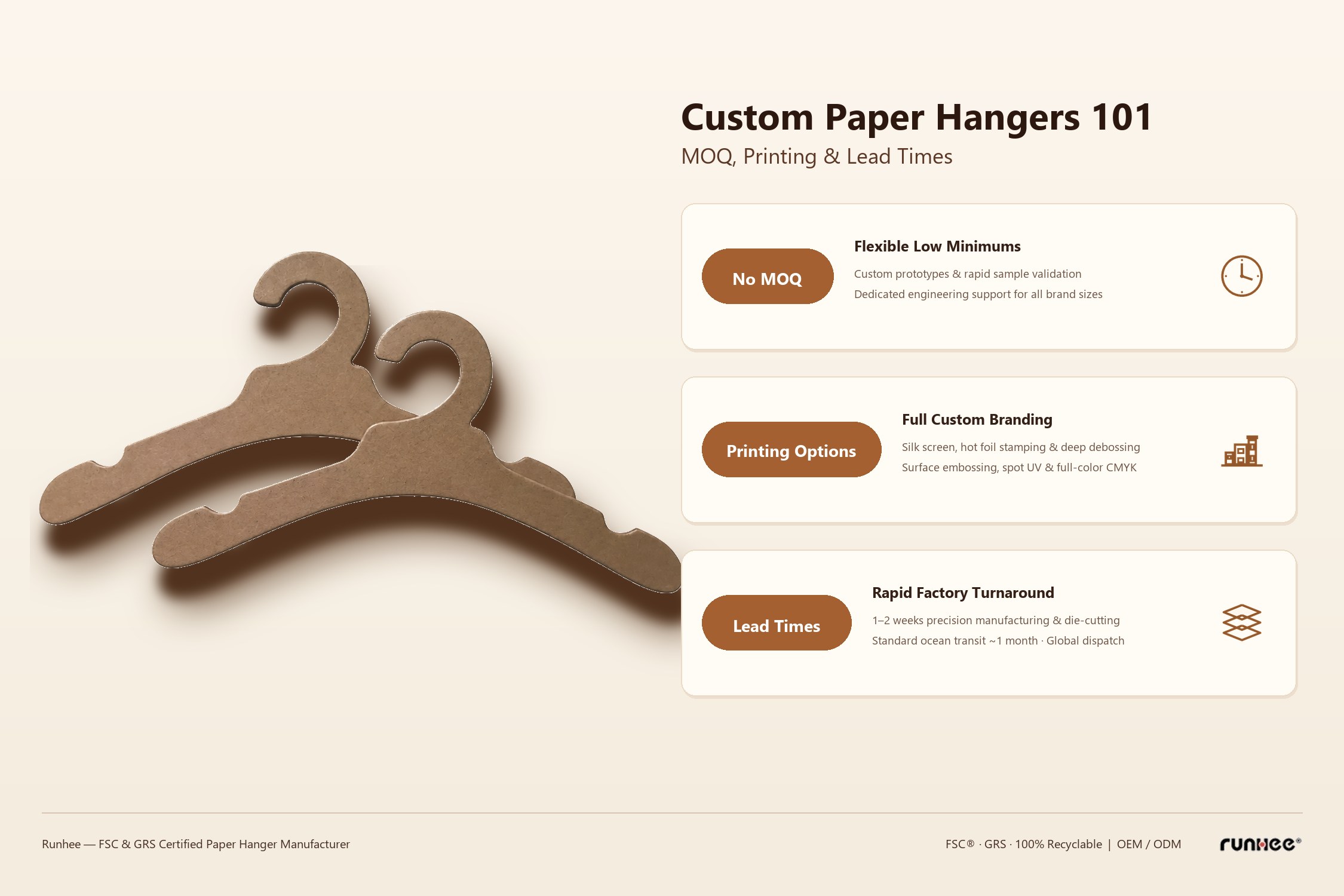
MOQ: Why There Is No Standard NumberFor brand owners and procurement professionals, minimum order quantity is always a key concern. In today's international trade environment, if you send enquiries to dozens of factories, you'll receive ten different MOQ figures. The reason is not that factories are quoting randomly — it's that MOQ is determined by the die-cutting tooling and post-production processes.
We generally categorise this into two scenarios. One involves standard designs using existing cutting dies, which allow for extremely low MOQs. The other involves specific requirements that require new tooling, where the initial order quantity is typically higher and some manufacturers may charge a moulding fee.
At Runhee, we offer extremely low MOQs or even no minimum order quantity at all, supported by our automated equipment and experienced production team. Over the past two months, together with our European office, we have recorded more than twenty low-MOQ orders, all of which received positive feedback from customers. Our motto has always been "One Runhee, One Better World" — pursuing growth while staying true to our mission as an environmentally conscious manufacturer.
Printing and Finishing: Where Craft Meets Brand
Printing and finishing matter — whether it's surface aesthetics, hollow-out detailing, or structural precision, every detail is refined. The table below shows the most common options:
Finish
Effect
Best For
Offset printing
Multi-color, gradients, detailed artwork
Brand logos, product information
Hot stamping
Metallic gold or silver
Premium brands
Embossing / Debossing
Raised or recessed texture
Minimalist brands
UV spot coating
Gloss contrast on matte surface
Logo emphasis
Laser engraving
Fine lines, precise detail
Minimalist design
Silk screen printing
Fine lines, precise detail
Bold single-color graphics
One reminder: the right finish depends on the board type — kraft, white coated, or black coated — and your brand positioning. More finishes don't always mean a better result.
Lead Times and Dispatch: It Starts with Cooperation
Production and dispatch times depend heavily on close cooperation with the client. All we need is for you to send design files (AI, PDF, or other formats) in a timely manner. If no design files are available, a concept is enough — and we can keep it confidential. Our specialist team will design and print the items using professional machinery. This process typically takes one to two weeks. Shipping generally takes around one month, and the rigidity and lightweight nature of cardboard products also help keep freight costs down.
On that note, our factory's design expertise, the 30,000+ design solutions accumulated over 16 years, and the dozens of patents we obtained as early as the 2010s mean we can resolve almost any challenge in this industry. If you have any queries, please email us — we're happy to help.
Where Do Your Final Costs Come From?
Cost Item
What It Covers
Die-cutting tooling
One-time charge; more complex shapes cost more
Printing plates
Based on number of colors and processes
Material
Determined by board grammage and type
Labour and post-press
Hot foil stamping, embossing, and other finishing add labour hours
The Bottom Line
Custom paper hangers are easier to develop than most brands expect. There is no injection mold to invest in, no minimum order quantity blocking your first test, and no limit to the printing and finishing options available. What matters is working with a manufacturer that can guide you through tooling, sampling, and production without surprises.
If you're planning a custom paper hanger project, tell us your garment type, target market, and estimated volume. We'll recommend the right structure and send a sample. Visit runhee.com.
Why is there no standard MOQ for custom paper hangers?
Because MOQ is determined by die-cutting tooling and post-production processes. Standard designs using existing cutting dies allow for extremely low MOQs. New structures require new tooling, so the initial order quantity is typically higher, and some manufacturers may charge a molding fee. Runhee offers very low MOQs or no minimum at all, supported by automated equipment and an experienced production team.
Which printing and finishing options are available, and how do I choose?
Common options include offset printing, hot stamping, embossing/debossing, UV spot coating, laser engraving, and silk screen printing. The right finish depends on the board type — kraft, white coated, or black coated — and your brand positioning. More finishes don’t always mean a better result. Runhee can recommend the most suitable combination based on your design and target market.
How long do production and shipping take for custom paper hangers?
Production depends on close cooperation with the client. Once you send design files (AI, PDF, or other formats), our specialist team designs and prints using professional machinery. This typically takes one to two weeks. Shipping generally takes around one month. Cardboard products are rigid and lightweight, which also helps keep freight costs down.
What are the main cost items for custom paper hangers?
Costs mainly come from die-cutting tooling, printing plates, material, and labour/post-press. Die-cutting tooling is a one-time charge; more complex shapes cost more. Printing plates depend on the number of colors and processes. Material is determined by board grammage and type. Labour and post-press cover hot foil stamping, embossing, and other finishing. There is no injection mold to invest in, so custom paper hangers are easier and cheaper to develop than many brands expect.