How to Choose the Right Paper Hanger Manufacturer: 5 Key Factors
Sep, 15 2026
Why the Right Partner Matters
There is no shortage of companies offering paper hangers, and that is part of the problem. A quote is easy to find; a manufacturing partner who can hold quality and delivery over multiple orders is not. The real differences show up later — in batch consistency, documentation, and how a supplier responds when something goes wrong. Runhee has manufactured paper hangers since 2010 and delivered over 1.2 billion pieces to brands and retailers worldwide. That scale only works if the underlying process is stable. Below are five factors that separate factories worth building a program around from those that only look good in a first sample.
1. Factory Ownership and Production Infrastructure
Start by confirming whether the supplier controls its own factory or operates as an intermediary. A manufacturer with in-house die-cutting, laminating, and printing gives the buyer direct influence over quality and schedule. A trading company adds distance, cost, and slower problem-solving.
Runhee operates its own die-cutting, printing, and testing facilities in Dongguan, with a material library covering kraft, white coated, and black coated paperboard. Buyers are welcome to request factory footage or a live video walkthrough. A genuine operation will accommodate that request without hesitation. A supplier that avoids it is telling you something.
2. Certification and Compliance Standing
FSC and GRS are the two documents most retail buyers expect to see. FSC covers responsible sourcing of the paperboard. GRS addresses recycled content and production practices. Without both, a supplier is effectively blocked from many European and North American buying programs — and so is any brand sourcing through that supplier. With major retailers like Primark committing to eliminate single-use plastic by 2027, certified paper hangers are moving from a preference to a procurement requirement.
Runhee holds FSC, GRS, BSCI, SEDEX, ISO9001, and OEKO-TEX certifications. These are not just badges on a website — they are the documents retail compliance teams ask for during supplier audits. A factory that cannot produce them will slow down your entire qualification process.
3. Design Range and Customization Capability
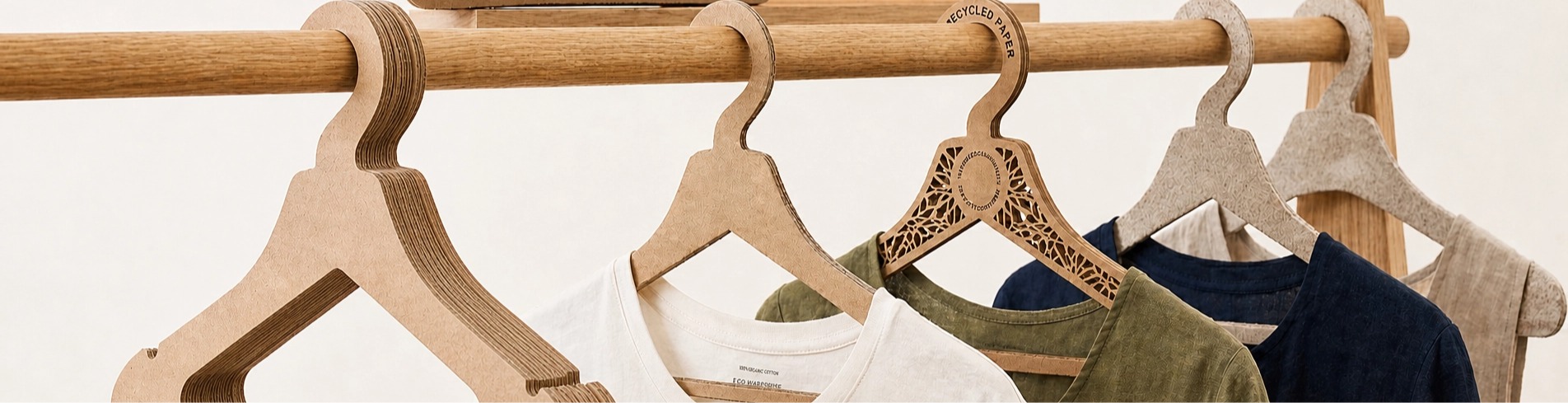
Paper hangers cover far more variety than they first appear to. A scarf hanger, a children's hanger, and a trouser hanger each require a different structure and thickness. A capable supplier should offer both standard formats and custom development from design files. Surface options should include offset print, UV coating, embossing, hot stamping, and laser engraving. The wider the in-house capability, the less the buyer has to manage externally.
This is one area where working with an established manufacturer makes a practical difference. Runhee develops hangers by garment type, with different board weights, shoulder angles, and end details for each category. For brands launching multiple product lines, this means one supplier can cover the full range instead of splitting orders across several factories.
4. Quality Verification and Testing Processes
Because paper hanger performance depends on material density and production control, testing should be standard practice. Load strength, moisture tolerance, and print accuracy all need batch-by-batch verification, not assumption. A factory with internal testing and report capability is a safer long-term option — especially for children's hangers, where product failure carries brand risk. Runhee uses compressed multi-layer recycled board and tests every design in-house before release. That testing discipline is what keeps batch consistency stable across repeat orders.
5. MOQ Structure, Pricing Transparency, and Lead Time Reliability
MOQ is shaped by tooling and finishing. Standard shapes with existing tooling can start lower. New structures require custom die-cutting, which increases setup cost and often raises the first order minimum. At Runhee, typical MOQs range from a few thousand to tens of thousands of pieces. To support both mass-market brands and smaller sellers, we also offer very low MOQs on trial orders, starting from 500 pieces. Sampling is free of charge when no printing is required; if printing is involved, the sample fee is typically around $30–$50, depending on the artwork. Lead times should be confirmed in writing, based on current production load, not on general estimates. Buyers who understand the full development path ask better questions and avoid the delays that come from unclear expectations.
One advantage of paper hangers over plastic is the tooling itself. Plastic hangers require injection molds, which can cost thousands of dollars per shape. Paper hangers use cutting dies instead, so custom profiles can be developed faster and at lower cost. This makes it easier for brands to iterate on design without being locked into one fixed format.
A Practical Next Step
Choosing a manufacturer is not only about comparing quotes. It is about confirming factory ownership, certification, customization depth, testing discipline, and commercial flexibility. Those five factors determine whether a paper hanger program runs smoothly over multiple seasons, or creates problems that only appear after the first order ships.
For a closer look at how paper hangers perform against plastic in real retail use, read: Paper Hangers vs Plastic Hangers: A Complete Comparison for Retailers.
related products:
FSC Kraft Paper Underwear Hanger Wave Claw Custom
GRS Recycled Plastic Hangers Wholesale OEM