other
  • How to Import Paper Hangers from China: A Buyer's Guide to Certifications, Costs & Lead Times
    How to Import Paper Hangers from China: A Buyer's Guide to Certifications, Costs & Lead Times
    Oct, 09 2026
      China is the primary production base for paperboard hangers, hooks, and retail displays. Paperboard mills, printing, die-cutting, and packing are concentrated in the same region, which makes lead times more predictable and costs more competitive. Public data shows China's hanger industry is highly concentrated: Guangxi's Lipu alone produces over 4 billion hangers of all materials per year, accounting for more than 70% of national output and exports. While Lipu is known mainly for wooden hangers, the same cluster effect also supports efficient paper hanger production. Runhee has manufactured paper hangers in Dongguan since 2010 and delivered over 1.2 billion units worldwide. Annual capacity is 300 million paper hangers and 500 million paper hooks, with in-house die-cutting, printing, and testing. Dongguan is the core of South China's paper processing industry. In 2025, the city's paper and paperboard output reached 14.77 million tons, about one-tenth of China's total, and the paper industry recorded 86.01 billion RMB in revenue, ranking first among all prefecture-level cities. Zhongtang paper base alone hosts 64 paper and paper product companies, forming a complete supply chain from raw paper to printing, die-cutting, and packaging. Working directly with a factory means quotes are based on production cost plus reasonable profit, with no middleman markup. Trading companies typically add 5–15%. For large standard orders, factory-direct sourcing can save 15–30% in procurement cost. If you are comparing suppliers, learn more about our [in-house paper hanger production line] and how we control quality from raw material to finished goods.     Certifications and Compliance: What to Confirm Before You Order Sourcing hangers from China is no longer about simply having a certificate. Certification must be verifiable. For paper hangers, the most important is FSC CoC (Chain of Custody). FSC has two main types: FM (Forest Management) and CoC. A paper hanger factory needs CoC, not FM. CoC proves that FSC-certified material is traceable from paperboard sourcing through to the finished product. The standard follow-up question is: Do you hold CoC certification, and does your certificate cover paper hangers? Runhee holds an FSC CoC certificate issued by Bureau Veritas, covering FSC 100%, FSC Mix, and FSC Recycled paper products, including paper hangers, hooks, and displays. Certificate number and scope are available upon request via WhatsApp or email. We also hold GRS, BSCI, SEDEX, ISO9001, OEKO-TEX, and Disney FAMA. These certifications should be displayed on the website and provided as documents during quotation.     Cost Breakdown: What Is Included in the Price A low unit price does not always mean a lower total cost. Paper hanger quotations vary widely depending on what is included. Before comparing suppliers, ask for a clear breakdown of material, printing, die-cutting, packing, certification, and freight. A standard quotation usually covers material, printing, die-cutting, and packing. Material options include recycled paperboard in kraft, white coated, or black coated finishes. Thickness ranges from 1.5mm to 3.5mm, customizable by product and load requirement. Printing options include offset, UV, hot stamping, embossing, laser engraving, and lamination. Packing is typically standard export cartons, with custom retail-ready packaging available on request.   What is often not included: freight, import duties, and third-party testing fees. Sampling may carry a fee — Runhee charges $30–$50 if printing is required, deductible from the bulk order. If no printing is needed, samples are free. Paper hangers have no injection mold cost because they are die-cut; custom shapes require only a cutting die, not an expensive plastic tool. This makes design changes faster and cheaper, especially for brands testing multiple structures. Paper hangers are also flat-packed and lightweight, reducing carton volume and lowering freight cost per unit compared with plastic hangers. MOQ is shaped by tooling and printing. Runhee operates with No MOQ and supports a 500-piece trial order, so brands can test the market before committing to larger volumes.     Shipping & Lead Times: Sea vs Air, FOB vs DDP Most paper hanger orders ship by sea. Sea freight is cost-effective for bulk orders, with typical lead times of 25–35 days depending on the destination port and customs clearance. Air freight is faster but more expensive, usually only used for urgent samples or small trial orders. Paper hangers have a logistics advantage: they are flat-packed and lightweight. Compared with plastic hangers, this reduces carton volume and lowers freight cost per unit, which is significant for large retail programs.   You will also need to choose between FOB and DDP. FOB means you handle freight and customs from the Chinese port. DDP means the supplier delivers to your door, with duties and taxes included. DDP is simpler, but FOB gives you more control over freight costs. Runhee supports both and can recommend the best option based on your order volume and destination. Standard sampling takes around 15 working days. Bulk production runs 15–25 working days after sample approval. Runhee operates in-house die-cutting, printing, and testing in Dongguan, which allows us to control both quality and schedule.     Supplier Vetting & Order Process Before placing an order, confirm whether the supplier is a direct factory or a trading company. A manufacturer with in-house die-cutting, laminating, and printing gives you direct influence over quality and schedule. Trading companies add a layer between the factory and the buyer, typically increasing prices by 5–15% and slowing down problem-solving. Runhee is a direct manufacturer based in Dongguan, China, with in-house die-cutting, printing, and testing capabilities. We hold FSC CoC, GRS, BSCI, SEDEX, ISO9001, and OEKO-TEX certifications.   The standard order process is straightforward: send your requirements (size, shape, thickness, printing, logo, quantity) → sampling around 15 working days, free if no printing is required → sample approval → bulk production 15–25 working days after approval → shipping by sea or air, FOB or DDP. If you are sourcing paper hangers for a retail project, contact Runhee. We can provide a quote, FSC certificate details, and a free sample for evaluation. We'll reply within 24 hours.   Related products:  FSC Certified Kraft Paper T-Shirt Clothing Hanger FSC Certified Eco Kraft Paper Sock Hanger   Runhee holds an FSC CoC certificate issued by Bureau Veritas, covering FSC 100%, FSC Mix, and FSC Recycled paper products. Certificate number and scope available upon request. FSC® is a trademark of the Forest Stewardship Council. © Runhee
  • Paper Hangers 101: What Brand Owners Need to Know About MOQ, Printing, and Lead Times
    Paper Hangers 101: What Brand Owners Need to Know About MOQ, Printing, and Lead Times
    Sep, 21 2026
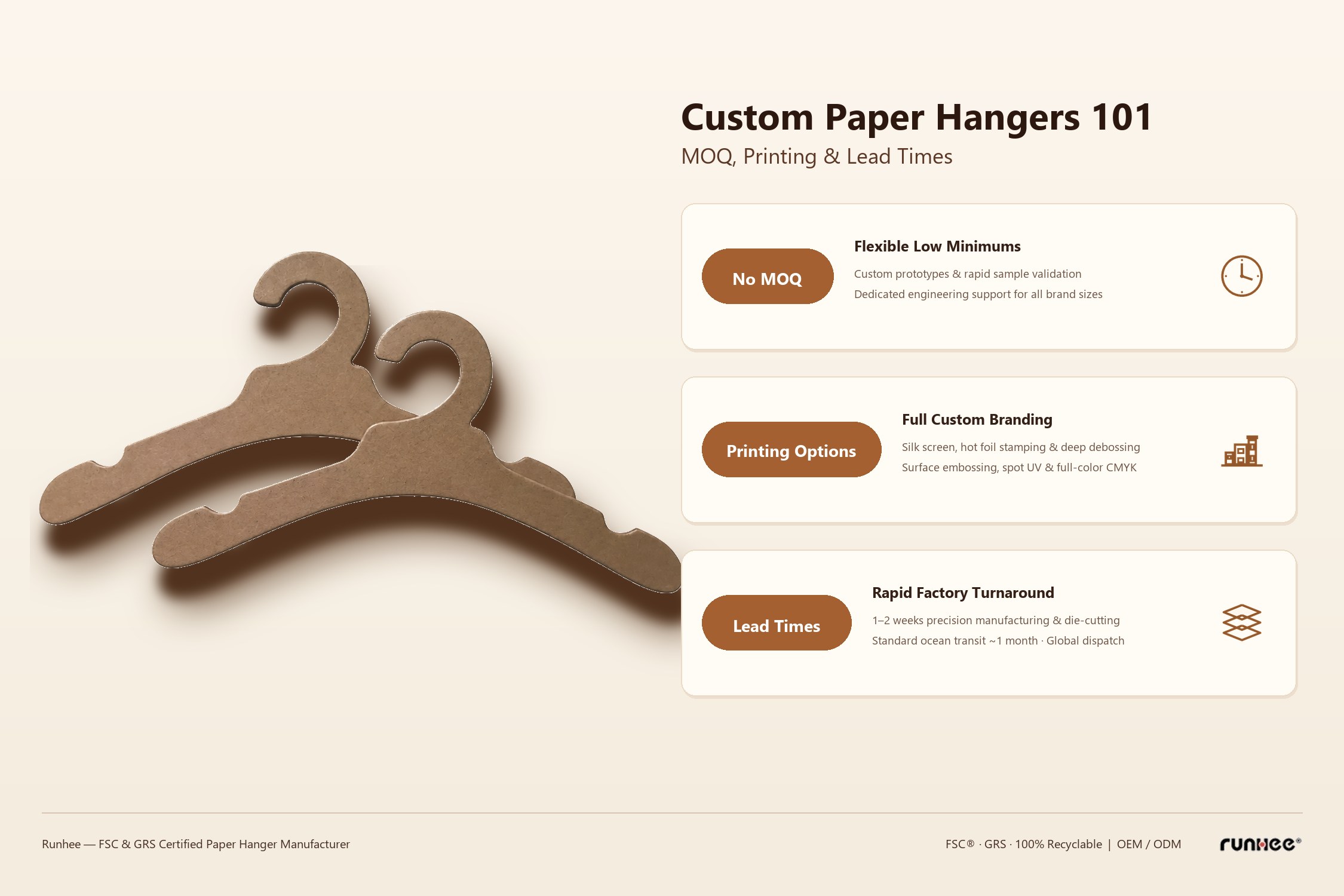
      Whether you're new to the paper hanger industry or already an experienced buyer, working in this sector requires understanding a few key factors: who the customers are, who the suppliers are, where the market is, and what drives demand. Based on our 16 years in this sector, and from our perspective as a manufacturer, demand for paper hangers has been consistently rising in developed regions such as Europe, the US, Japan, and South Korea. This is one reason we chose this industry: the environmental benefits of paper products are long-lasting, harmless, and beneficial. According to Two Sides, over 60% of consumers consider the environmental impact of packaging when making purchasing decisions. That's a valuable lesson — economic growth and environmental responsibility can go hand in hand. A further 43% of consumers regularly check whether products are recyclable.     MOQ: Why There Is No Standard NumberFor brand owners and procurement professionals, minimum order quantity is always a key concern. In today's international trade environment, if you send enquiries to dozens of factories, you'll receive ten different MOQ figures. The reason is not that factories are quoting randomly — it's that MOQ is determined by the die-cutting tooling and post-production processes. We generally categorise this into two scenarios. One involves standard designs using existing cutting dies, which allow for extremely low MOQs. The other involves specific requirements that require new tooling, where the initial order quantity is typically higher and some manufacturers may charge a moulding fee. At Runhee, we offer extremely low MOQs or even no minimum order quantity at all, supported by our automated equipment and experienced production team. Over the past two months, together with our European office, we have recorded more than twenty low-MOQ orders, all of which received positive feedback from customers. Our motto has always been "One Runhee, One Better World" — pursuing growth while staying true to our mission as an environmentally conscious manufacturer.     Printing and Finishing: Where Craft Meets Brand Printing and finishing matter — whether it's surface aesthetics, hollow-out detailing, or structural precision, every detail is refined. The table below shows the most common options: Finish Effect Best For Offset printing Multi-color, gradients, detailed artwork   Brand logos, product information Hot stamping Metallic gold or silver Premium brands Embossing / Debossing Raised or recessed texture Minimalist brands UV spot coating Gloss contrast on matte surface Logo emphasis Laser engraving Fine lines, precise detail Minimalist design Silk screen printing Fine lines, precise detail Bold single-color graphics One reminder: the right finish depends on the board type — kraft, white coated, or black coated — and your brand positioning. More finishes don't always mean a better result.   Lead Times and Dispatch: It Starts with Cooperation Production and dispatch times depend heavily on close cooperation with the client. All we need is for you to send design files (AI, PDF, or other formats) in a timely manner. If no design files are available, a concept is enough — and we can keep it confidential. Our specialist team will design and print the items using professional machinery. This process typically takes one to two weeks. Shipping generally takes around one month, and the rigidity and lightweight nature of cardboard products also help keep freight costs down. On that note, our factory's design expertise, the 30,000+ design solutions accumulated over 16 years, and the dozens of patents we obtained as early as the 2010s mean we can resolve almost any challenge in this industry. If you have any queries, please email us — we're happy to help.     Where Do Your Final Costs Come From? Cost Item What It Covers Die-cutting tooling One-time charge; more complex shapes cost more Printing plates Based on number of colors and processes Material Determined by board grammage and type Labour and post-press Hot foil stamping, embossing, and other finishing add labour hours   The Bottom Line Custom paper hangers are easier to develop than most brands expect. There is no injection mold to invest in, no minimum order quantity blocking your first test, and no limit to the printing and finishing options available. What matters is working with a manufacturer that can guide you through tooling, sampling, and production without surprises. If you're planning a custom paper hanger project, tell us your garment type, target market, and estimated volume. We'll recommend the right structure and send a sample. Visit runhee.com.     Why is there no standard MOQ for custom paper hangers? Because MOQ is determined by die-cutting tooling and post-production processes. Standard designs using existing cutting dies allow for extremely low MOQs. New structures require new tooling, so the initial order quantity is typically higher, and some manufacturers may charge a molding fee. Runhee offers very low MOQs or no minimum at all, supported by automated equipment and an experienced production team. Which printing and finishing options are available, and how do I choose? Common options include offset printing, hot stamping, embossing/debossing, UV spot coating, laser engraving, and silk screen printing. The right finish depends on the board type — kraft, white coated, or black coated — and your brand positioning. More finishes don’t always mean a better result. Runhee can recommend the most suitable combination based on your design and target market. How long do production and shipping take for custom paper hangers? Production depends on close cooperation with the client. Once you send design files (AI, PDF, or other formats), our specialist team designs and prints using professional machinery. This typically takes one to two weeks. Shipping generally takes around one month. Cardboard products are rigid and lightweight, which also helps keep freight costs down. What are the main cost items for custom paper hangers? Costs mainly come from die-cutting tooling, printing plates, material, and labour/post-press. Die-cutting tooling is a one-time charge; more complex shapes cost more. Printing plates depend on the number of colors and processes. Material is determined by board grammage and type. Labour and post-press cover hot foil stamping, embossing, and other finishing. There is no injection mold to invest in, so custom paper hangers are easier and cheaper to develop than many brands expect.      

leave a message

leave a message
If you are interested in our products and want to know more details,please leave a message here,we will reply you as soon as we can.

Home

Products

whatsApp

Contact

Start a Conversation

Hi! Click one of our members below to chat on