
The Hidden Cost of Plastic Hangers: A TCO Analysis for Procurement Managers


Author
Miss Zhong


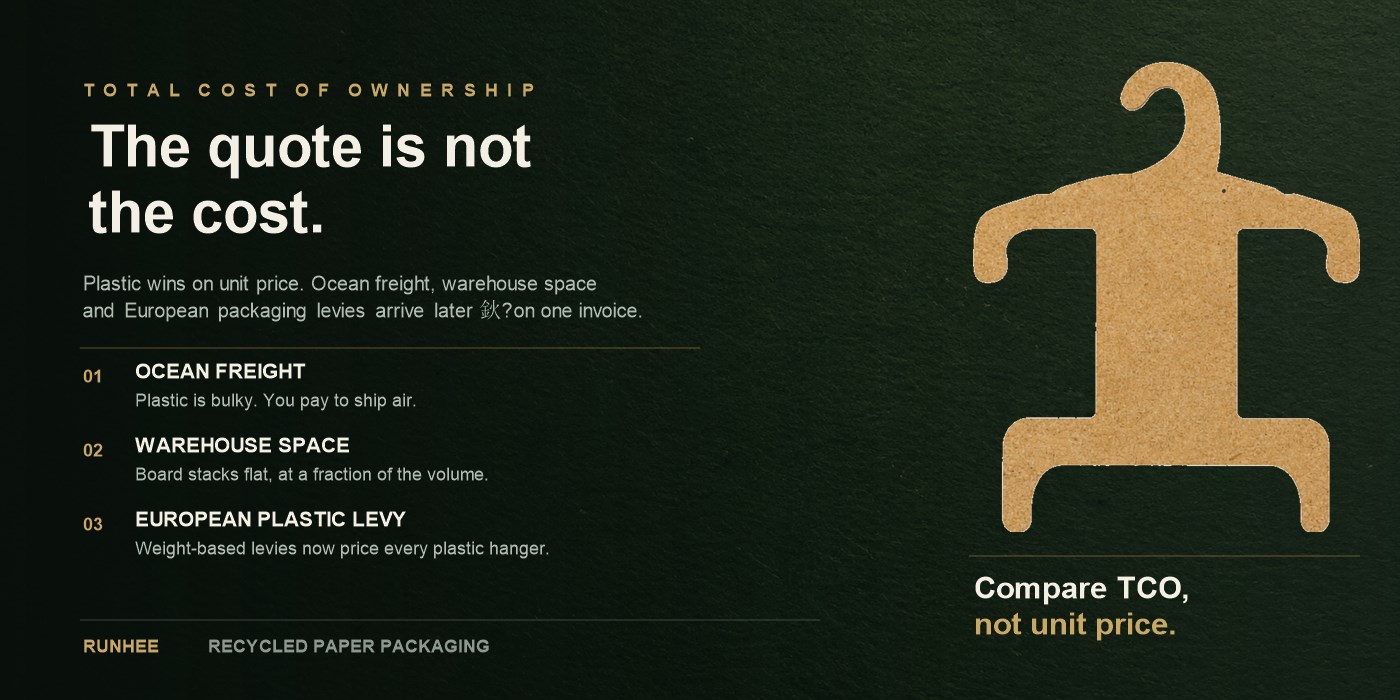
Many brands still purchase plastic hangers because the initial unit price seems lower than custom cardboard hangers. However, the initial quote is only the cost of the product—it doesn't tell the whole story. Ignoring hidden supply chain costs is a financial trap that eats into your margins.
To truly understand your costs, you must calculate the Total Cost of Ownership (TCO). If you only focus on the unit price while ignoring international freight, warehouse space, and new European tax penalties, your real costs are skyrocketing without you realizing it.
1. The "Volume Weight" Freight Trap
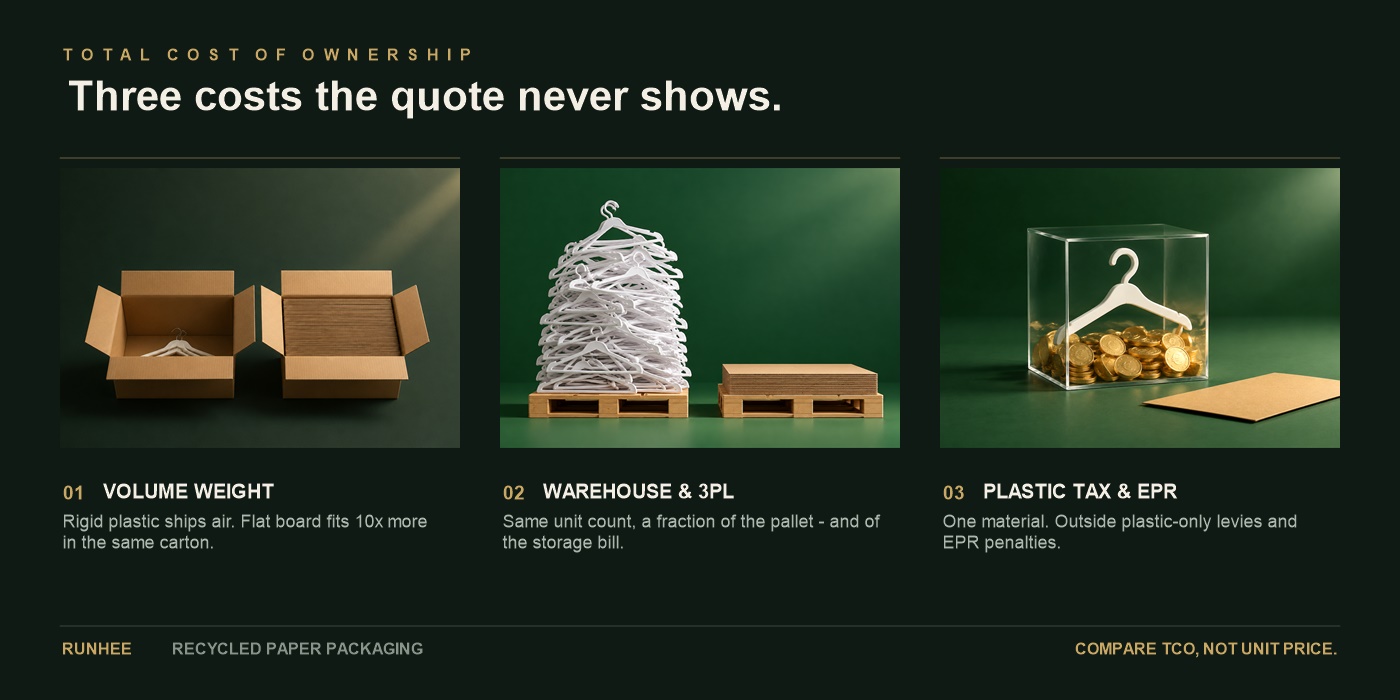
International shipping is billed by volume (CBM), not just actual weight. Plastic hangers are rigid and bulky, wasting massive amounts of space during transit. You should not be paying to ship empty air.
The TCO Math: Our wholesale paper hangers are 100% flat-packed (unless structural assembly is specifically requested). A single carton can hold up to 10 times more flat-packed paper hangers than assembled plastic ones. This slashes your ocean and air freight costs by up to 80%, instantly offsetting the difference in unit price.
2. Warehouse Rent & 3PL Storage
In the US and Europe, warehouse space is extremely expensive. A pallet of 10,000 plastic hangers takes up massive volume, while a pallet of 10,000 flat-packed paper hangers takes up only a fraction of that space. By switching to paper, you can reduce your warehouse footprint, lower your 3PL storage fees, and improve your inventory turnover rate.
3. The EU Plastic Tax & EPR Penalties
Plastic packaging is being taxed heavily. The UK Plastic Packaging Tax charges up to £228/tonne for plastics with less than 30% recycled content. Furthermore, under the EU PPWR, brands are facing rising EPR (Extended Producer Responsibility) fees for hard-to-recycle mixed materials. Our FSC-certified paper hangers are 100% single-material, completely exempt from plastic-specific taxes, and align with eco-modulated fee reductions.
The Bottom Line
If you import 1 million hangers a year, saving $0.02 on the plastic unit price means nothing if you pay $20,000 more in freight and double your warehouse costs.
Don't let hidden supply chain costs destroy your margins. Let's calculate your true TCO.
What are the "hidden packaging costs" of garment hangers?
Costs that never appear on the hanger quote: ocean and air freight billed by cubic metre, warehouse and 3PL storage, inventory holding cost, and plastic-specific taxes and EPR fees now applied in the UK and EU. The quote covers the product; these four arrive on separate invoices, months later.
What is the total cost of ownership (TCO) of a hanger?
TCO is unit price plus every cost triggered by that unit after purchase — freight, storage, compliance, and end-of-life fees. For hangers, the largest variable is not the material price but the volume the material occupies in transit and in storage.
Why is international freight charged by volume instead of weight?
Most ocean and air rates are billed on chargeable weight, which is the greater of actual weight and volumetric weight (CBM × a density factor). Hangers are extremely light for their size, so volumetric weight almost always wins — you are charged for the space, not the grams.
How much can flat-packed paper hangers reduce freight costs?
In our own shipments, flat-packed paperboard hangers cut ocean and air freight spend by up to 80% compared with assembled plastic hangers, because a single carton can hold up to 10x more pieces. The exact figure depends on hanger profile, carton size and your lane.